


Views: 0 Author: Site Editor Publish Time: 2026-10-08 Origin: Site


An Aluminum Privacy Gap Fence can screen a yard while allowing light and air to pass between its slats. A full privacy design offers a more continuous visual barrier, but its larger solid area can change the loads on posts and foundations. Choosing between them involves more than appearance: the layout, local exposure, ground conditions, gate requirements and installation method all affect the finished project. This guide explains the practical trade-offs, the components that drive cost, and the checks to make before ordering or installing an aluminum privacy fence.
Choose gap spacing and fence height around actual viewing angles, not appearance alone.
Compare complete installed quotations, including posts, gates, foundations and site work.
Use the selected system’s instructions and project-specific structural requirements for post spacing, fixings and foundations.
Aluminum does not rot like wood, but coatings, fasteners and post connections still need periodic inspection.
A privacy fence uses closely spaced members or solid infill to limit views across a boundary. An aluminum gap fence deliberately leaves openings between its slats. From some positions those openings provide ventilation and filtered views; from others, especially when the observer looks straight through, the interior may be visible. A design described as semi-private therefore needs to be evaluated in the context of the property, not assumed to block every sightline.
Shengjie’s black aluminum gap fence illustrates a horizontal semi-privacy approach. The dark finish creates a strong boundary line while the spaces between the members retain a more open appearance than a closed panel.
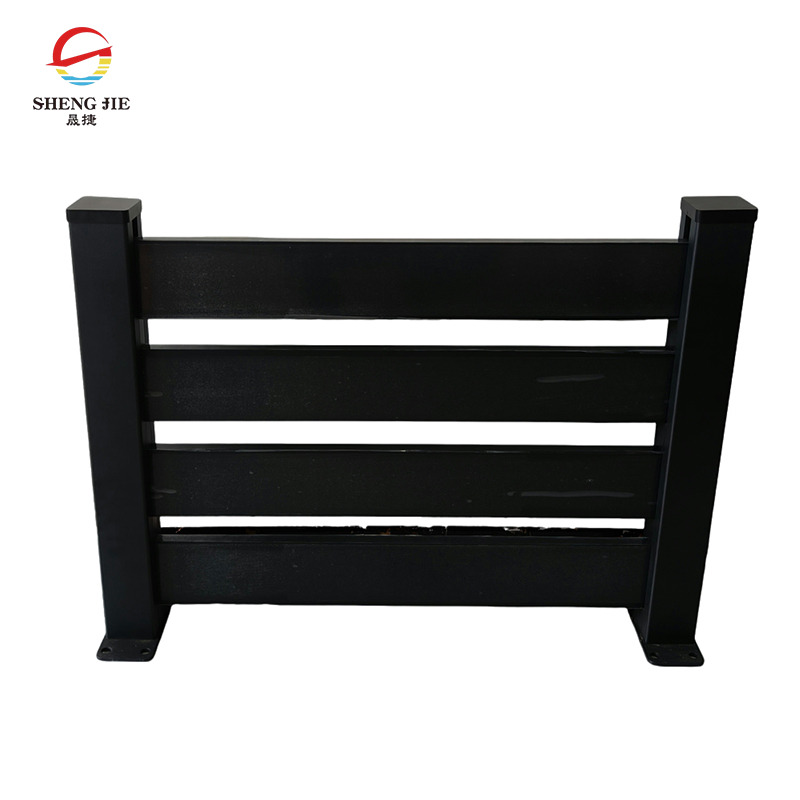
For a seating area directly opposite an upstairs window, a small horizontal opening may still reveal activity inside the garden. For a long side boundary viewed mostly at an angle, the same spacing may feel substantially more private. Test samples at the intended height and view them from the street, neighboring windows and the most frequently used outdoor spaces.
A full privacy fence closes more of the visible area. It may suit a patio, service yard or boundary where direct screening is the priority. The trade-off is that a more closed fence can intercept more wind; its structural design, post spacing and anchorage must be checked for the particular site and system.
Aluminum will not rot or be eaten by termites. A finished aluminum surface typically needs washing and inspection rather than the repeated staining or sealing associated with many timber fences. That does not mean maintenance disappears. Dirt can collect on horizontal surfaces, damaged coatings should be assessed and fasteners can deteriorate if they are unsuitable for the environment.
Coastal exposure, deicing salts, irrigation water and accumulated debris can affect the finish and connections. Ask the supplier which coating and hardware are appropriate for the location, and follow its cleaning and repair instructions. Do not assume that all powder coatings have the same resistance or warranty terms.
Metal profiles can provide a consistent line along walls, gardens and gates. Horizontal slats emphasize length, while vertical members can make a compact boundary feel taller. Panel proportions, post visibility and top-edge alignment are just as important as the color itself.
There are limits to this consistency. Uneven ground may require stepped panels, a system designed to follow the slope, or a combination of short runs and transitions. A straight top line can look polished, but large changes in ground level may leave undesirable openings underneath. Review the finished elevation from both sides before deciding which compromise works.
A fence can discourage casual access without being a certified security barrier. Gates, hinges, latches and attachment points are often the more useful items to evaluate when controlled access matters. Similarly, ordinary slatted fencing should not be treated as a guaranteed acoustic solution: openings allow sound to pass, and actual performance depends on the entire barrier, its geometry and the source of the sound.
Near a pool or other regulated hazard, a decorative privacy fence must not be assumed to satisfy barrier rules. Check the local requirements for height, openings, climbable elements and gates, and use an appropriately designed assembly where required.
There is no reliable universal installed price for an aluminum fence. A panel price alone does not capture labor, foundations, delivery or the details of the site. Currency, local labor rates and the selected product also vary, so a useful budget starts with quantities and inclusions rather than an unqualified price per foot.
Cost item | What changes the quote | Question to ask |
|---|---|---|
Panels and infill | Height, profile, finish, privacy level and total run | Is the quoted unit a complete panel, a board or an area? |
Posts and hardware | Ends, corners, transitions, brackets and fasteners | Are all post types and caps included? |
Foundations | Soil, wind exposure, existing surfaces and design requirements | Are excavation, concrete and disposal included? |
Gates | Opening width, frame, hardware and access method | Does the price include hinges, latch and gate posts? |
Site work | Removal, access, slopes, obstacles and surface repairs | What work is excluded or charged separately? |
To compare bids fairly, give each supplier the same drawing. Show each straight run, corner, return, gate opening and change of level. Specify whether the quote should include removal of an old fence, haulage, installation and taxes. A lower panel price may become a higher project price once additional posts, freight and ground works are added.
Consider the useful life of the finish and hardware as part of the budget, but avoid assuming a fixed service life without product-specific evidence. A slightly higher initial cost may be worthwhile when it buys a coating suitable for the environment, a well-detailed gate or access to replacement components. Conversely, extra decorative features may add cost without improving the privacy that the buyer actually needs.
Identify the property boundary and the proposed fence line before ordering. Determine whether permits, setback rules, neighborhood restrictions or shared-boundary agreements apply. Arrange the relevant underground utility checks before any digging. Requirements differ by location; the installer and property owner need to resolve them before work starts.
Mark the proposed line on site. Measure each run independently rather than using the perimeter alone. Include corners, changes of direction, gate openings, walls, trees, drainage features and areas where equipment cannot reach. Note finished ground levels on both sides because the visible gap under the fence may differ.
Identify the exact views to screen. A person seated on a patio, a pedestrian at street level and a neighbor looking down from an upper floor have different sightlines. Mark a temporary reference at the proposed height and examine it from these positions. Height restrictions and structural requirements may limit the available options.
Select the slat direction and spacing after checking those views. A smaller gap can improve screening from some angles, but it can also change the visual weight and wind behavior of the panel. Ask for a sample or drawing that shows the actual gap, rather than relying on a distant photograph.
Posts transfer loads from panels and gates into the supporting ground or structure. Their size, spacing, embedment or base attachment should follow the selected system’s documented design and the conditions of the site. A post layout suitable for an open decorative fence cannot automatically be reused for a taller, more closed privacy panel.
Where a post is fixed to an existing slab or wall, verify the condition and capacity of the supporting structure as well as the anchor specification. A surface that looks sound may not be designed to resist the forces imposed by a fence. On exposed sites or where local rules require it, obtain a qualified design assessment before installation.
Follow the manufacturer’s installation sequence for the actual system. Establish a reference line, position the posts and check their alignment and verticality. If concrete foundations are used, allow them to reach the condition specified by the installer or product instructions before loading the posts. Do not apply a generic hole depth or concrete cure time to every location.
Fit the infill, rails and hardware in the specified order. Some systems use boards that slide into post channels; others use assembled panels and brackets. Check the permitted movement, edge clearances and fastening locations before cutting. Protect the finish during handling and treat exposed cut edges as directed by the supplier.
Gates need room to swing or slide without striking paving, planting or changes in ground level. Check the opening width with the hardware in place and ensure gate posts are designed for the gate’s weight and operation. After assembly, inspect fixings, caps, alignment, movement and clearance along the full fence line.
A skilled DIY installer may be comfortable assembling a straightforward system, but excavation, structural anchorage, difficult slopes and regulated barriers can justify professional help. The decision should reflect site risk and the installer’s ability to follow the documented design, not simply the number of parts in the kit.
A semi-private panel works well where a defined boundary is needed without creating a completely closed visual wall. It can be useful along a garden edge that benefits from filtered light or along a boundary where views are mostly oblique. The buyer should still check the view through the gaps at the most sensitive positions.
A closed design is better suited to a direct view into a seating area or service space. For a garden project, Shengjie also offers a full privacy garden fence. Compare the complete system, including posts and gates, rather than assuming that the same foundation layout will suit both designs.
Mixing designs can also be practical. A closed section near a patio may provide focused screening, while a semi-private run elsewhere keeps the garden visually open. Keep the transition deliberate: align top edges where possible, coordinate post profiles and confirm how the different panels connect at the junction.
Before ordering, ask for drawings showing panel width, overall height, post dimensions, gap width, gate details and site-specific fixing options. Request a written list of included components and a finish sample. If the supplier’s published specifications are inconsistent, obtain a project-specific confirmation instead of relying on an ambiguous table.
Wash the fence periodically using the coating supplier’s recommended method. Remove salt deposits, soil and leaf buildup, especially where moisture can remain trapped around the base. Avoid abrasive cleaning tools or aggressive chemicals unless the finish manufacturer explicitly permits them. Test any unfamiliar cleaning method on an inconspicuous area first.
Inspect posts, fasteners and gates after severe weather and during normal property maintenance. Look for looseness, coating damage, blocked drainage and gate movement. Address a damaged finish promptly using an approved repair method. If a post shifts or a panel deforms, identify the cause before tightening or replacing individual parts; the foundation or supporting structure may also need attention.
An aluminum privacy fence is most useful when its screening, support system and maintenance requirements are matched to the property. Choose a gap design when filtered views and a lighter appearance matter, and consider a closed panel where direct visual screening is essential. Compare complete quotations using the same layout and component list, then confirm the foundation and hardware requirements for the actual site. Shengjie’s semi-private and full privacy options provide starting points for that comparison, while the final specification should be agreed for the project.
No. Openings can allow views through the fence, particularly from a position directly opposite the gaps. The apparent screening changes with slat profile, spacing, viewing angle and the distance from the fence. A sample placed at the intended location is a useful way to assess the result.
Often, but the method depends on the panel system. Stepping creates level sections at different heights; a raked system follows the slope when designed to do so. Check the allowable slope and the ground clearance at each section before ordering.
Not always. A quotation may cover the infill only, a panel kit or a more complete assembly. Ask for a written bill of materials identifying posts, caps, brackets, fasteners, gates and delivery.
It may be, provided the coating, hardware and maintenance plan are suitable for the exposure. Salt deposits can affect finishes and connections, so obtain the product-specific recommendations and inspect the installation regularly.
Some systems use base-mounted posts, but suitability depends on the slab or wall, the anchors, fence geometry and local loads. Have the supporting structure assessed and use the approved mounting detail for the project.
Use the same measured layout and compare panel height, finish, posts, gates, foundations, removal, labor and delivery. Check exclusions and the written warranty terms for both materials and installation.


