


WPC Fence Panels offer a wood-inspired surface for buyers who want a defined outdoor boundary with less routine finishing than many timber fences. Their performance, however, depends on the formulation, surface, supports and installation details. Sunlight, moisture, cleaning habits and the way a fence is used all influence its appearance over time. Understanding those conditions helps homeowners, landscape professionals and commercial buyers choose a composite garden fence that fits the setting and remains practical to maintain.
Key Takeaways
- WPC is a family of composites; individual products can differ in formulation, surface and behavior.
- Low maintenance still includes cleaning, inspection and attention to drainage and hardware.
- Choose color, texture and privacy level using samples viewed in the intended outdoor setting.
- Assess the whole fence system, including posts, fixings and site conditions, before purchasing.
What WPC Fence Panels Are Made to Do
WPC generally combines wood-derived particles or fibers with a polymer and additives. The exact recipe, manufacturing process and any protective outer layer vary by product. The result can offer a wood-like texture without requiring the same routine staining or sealing as many unfinished timber products, but it is still a manufactured material with its own care and installation requirements.
Shengjie describes its outdoor WPC fence panels as combining wood powder with high-density polyethylene. For an actual project, confirm the board profile, surface, dimensions and compatible supports in writing, especially where a published specification is ambiguous.
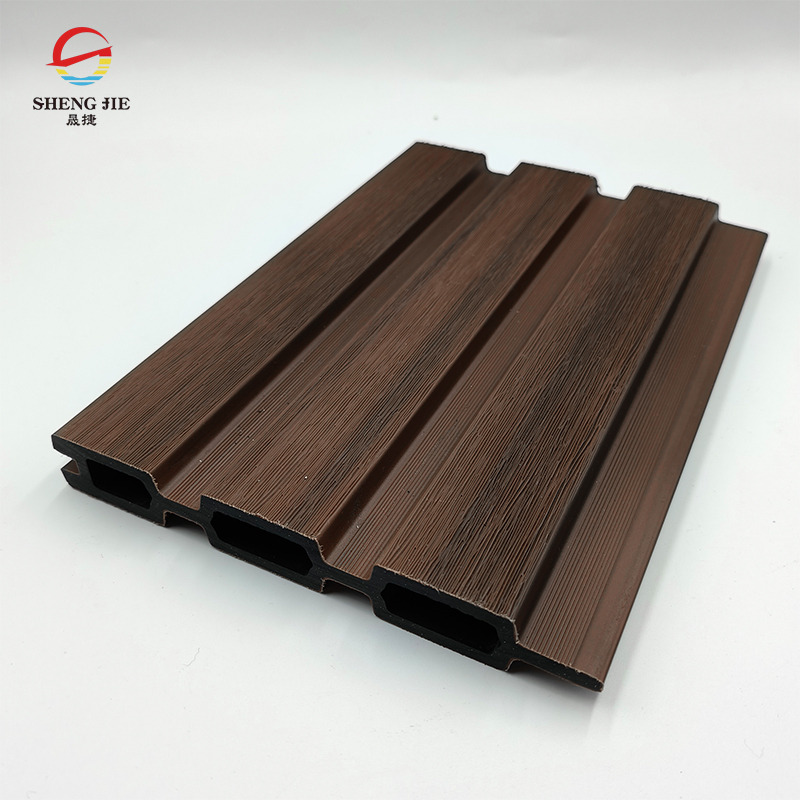
A fence is an assembly rather than a single material. Posts, foundations, fasteners, rails, gates and infill must work together. A board with an attractive surface cannot compensate for an unsupported span, a poorly anchored post or a gate that drags on the ground. Evaluate the complete system and its intended use.
Durability: What Matters in Real Outdoor Conditions
Sunlight and color change
Outdoor materials experience sunlight, heat and seasonal changes. WPC products may change color as they weather, particularly during initial exposure, but the extent and pattern depend on the formulation and surface. Ask the supplier what change is expected and whether its samples show new material, weathered material or both.
Look at samples in direct sunlight and shade. A dark board can create a crisp contrast with planting and paving, while a lighter board may make a small courtyard feel more open. Dark surfaces can become hot in direct sun, so consider where people might touch or lean against the fence.
Different orientations receive different amounts of exposure. A board protected by a roof or dense vegetation may age differently from one facing full sun. This is a reason to consider the entire installation when assessing color, rather than treating one protected sample as a guaranteed long-term match.
Rain, moisture and drainage
WPC is used outdoors, but its moisture response varies. Do not assume that every composite is waterproof or immune to swelling. Check the supplier’s guidance for ground clearance, ventilation and cleaning, and avoid installations that trap water or soil against the boards.
Leaves and soil can hold moisture near the base of any fence. Keep drainage paths clear and remove organic buildup. Where a fence sits near irrigation, reduce repeated wetting if practical and inspect for deposits or surface growth. The posts and hardware may have different maintenance requirements from the composite infill.
Impact, scratches and support
A garden fence may experience contact from tools, furniture, bicycles or maintenance equipment. Surface texture can influence how marks appear, but no finish should be assumed scratchproof. Request a sample for the people who will use the space, and ask about the supplier’s repair or replacement guidance.
Support matters as much as the surface. Long spans, excessive height or inappropriate post spacing can change how the fence behaves under load. Follow the specified layout and consult a qualified professional where the site or local requirements call for a structural assessment.
Temperature and dimensional movement
Composite boards can move as temperature and moisture conditions change. Proper end clearances, support and fastening allow the system to accommodate the movement anticipated by its manufacturer. The appropriate allowance depends on the product and board length; avoid generic numbers borrowed from an unrelated decking or fencing system.
During installation, do not force boards tightly into channels or fix them in a way that prevents intended movement. If an existing fence develops bowing or binding, inspect the supports and clearances as well as the boards. The cause may involve installation, exposure or a combination of factors.
How WPC Compares With Other Fence Materials
| Material | Potential appeal | Trade-off to evaluate |
|---|---|---|
| WPC composite | Wood-inspired finish with limited routine refinishing | Movement, surface care and performance depend on the product |
| Timber | Natural variation and familiar repair methods | Many species and finishes need periodic treatment and inspection |
| Aluminum | Metal profiles and resistance to rot | Finish, fasteners and structural supports still require care |
| Vinyl | Manufactured surface with a range of styles | Appearance, movement and repair options vary by system |
The right comparison uses the same fence height, privacy level, post layout and installation scope. A material-only comparison can conceal differences in gates, foundations and labor. Also consider whether the owner can obtain replacement components and how a damaged section would be repaired.
Timber may be attractive where a natural surface and on-site modification are priorities. Aluminum may suit a project seeking slender metal profiles or a particular contemporary finish. WPC can be appealing where a consistent wood-inspired surface and reduced refinishing are important. None is universally superior; the best choice depends on exposure, budget and appearance.
Designing a Composite Garden Fence That Fits the Space
Use texture and color deliberately
A wood-grain surface can add visual texture to a simple boundary. Compare the scale and direction of the grain with nearby decking, paving and building materials. Matching every surface exactly is not necessary; a controlled palette can provide continuity while allowing the fence to have its own role.
Ask whether the visible finish is on one or both faces and how cut ends, trims and posts will look. This matters on shared boundaries or in courtyards where both sides of the fence are visible. View several boards together if possible, as individual color variations can change the overall impression.
Balance privacy and openness
A closed board arrangement can screen a seating area, storage zone or garden from direct views. An open or partially screened arrangement may feel lighter where visual separation is more important than complete privacy. Confirm which arrangements the selected product supports and whether additional gaps affect the structural system.
Look at the boundary from the seating position and from the neighboring side. A fence tall enough for a pedestrian view may not block a view from an upper window. Use a temporary marker or sample to understand sightlines before deciding on a height.
Integrate gates and changes in level
A gate interrupts the repeated pattern of a fence. Decide whether the infill should align with the neighboring boards or whether the frame should be a visible design element. Confirm the gate’s clear opening, swing and hardware position before setting posts.
On sloping ground, stepped sections can keep boards level while creating changes in the bottom edge. A sloping arrangement is possible only if the selected system permits it. Draw the fence elevation and check the gaps beneath each section against the project’s privacy and containment needs.
Low-Maintenance Fencing Still Needs a Care Plan
Start with the supplier’s cleaning instructions for the exact board and surface. Routine care may include removing loose debris and washing with water and an approved mild cleaner. Test any unfamiliar product on a small inconspicuous area first. Avoid assuming that abrasive pads, solvents, pressure washing or strong chemicals are safe for all composites.
Clean marks promptly where practical. Grease, soil, pollen and organic matter may be easier to address before they accumulate. Do not scrape aggressively or sand a surface unless the manufacturer specifically recommends it; sanding can change texture or expose a different underlying layer.
Inspect the entire assembly periodically. Look for loose post caps, damaged fittings, debris lodged in channels, uneven gaps and gates that no longer latch properly. Check after severe weather or an impact. If a post moves, evaluate the foundation or fixing rather than assuming the board is responsible.
Keep a record of the product, color, supplier and installation date. Save the board profile and post details, along with written care instructions. If a damaged section needs replacement, an accurate record makes it easier to identify compatible parts and assess whether the appearance of a new piece may differ from weathered boards.
Where WPC Works Well—and Where to Ask More Questions
WPC fencing can be useful around gardens, patios, shared residential spaces and commercial landscape areas where a consistent visual boundary is desired. It can also form a backdrop to planting or separate utility areas from customer-facing spaces. The specific system must be suitable for the intended height, exposure and support arrangement.
Ask more questions on exposed sites, where the fence is unusually tall, where the ground is difficult or where a mounting surface is already in place. Higher loads can affect posts and foundations. A product photograph cannot establish the correct design for those conditions.
Do not assume a decorative fence is a pool barrier, guardrail, acoustic wall or security-rated assembly. Each of those uses can involve distinct rules and documented performance requirements. Specify the actual purpose and obtain the appropriate system and local professional review when required.
For projects with fire-performance requirements, request the relevant classification or test evidence for the actual product and assembly. A composite may contain combustible materials, and a general description such as “outdoor” or “eco-friendly” is not evidence of a fire rating.
Environmental Claims and Purchasing Checks
Some WPC products use recycled constituents, but recycled content, sourcing and end-of-life options differ. A product that contains recycled material is not automatically recyclable in every local system. Ask for the documented composition and local recycling route if those factors matter to the project.
Estimate service and replacement needs alongside the initial purchase. A durable assembly may reduce the frequency of replacement, but claims about lifetime environmental impact require a defined comparison and evidence. Avoid treating any single material as automatically the most sustainable option in every location.
When reviewing the WPC panel fence range, request a current drawing, installation instructions, finish sample and complete bill of materials. Confirm compatible posts, gates and spare parts. Compare written warranty conditions, including exclusions and the responsibilities of the installer and owner.
For a larger development, install a representative mock-up before approving the full order when feasible. It can reveal the appearance of joints, posts, color variation and transitions that are hard to judge from a small sample. The mock-up also allows the maintenance team to review access and cleaning needs.
Conclusion
WPC can provide a consistent, wood-inspired boundary with a manageable care routine when the chosen system suits the site. Its long-term appearance depends on exposure, cleaning, movement allowances and the condition of the supporting structure. Compare samples and complete assemblies, not only material names, and obtain product-specific instructions before installation. Shengjie’s WPC fence offering is one starting point for that evaluation; the final choice should reflect the project’s privacy, appearance and maintenance priorities.
FAQs
Do WPC Fence Panels need painting or staining?
Many are designed to be used without routine painting or staining. Check the specific product instructions before applying a coating, because an unapproved finish may perform poorly or affect warranty coverage.
Will a WPC fence fade outdoors?
Some change in color can occur with exposure. The degree and timing depend on the formulation, surface and site. Ask for the supplier’s expectations and examine a weathered sample if available.
Can plants grow against a composite fence?
Planting can be placed nearby, but allow room for airflow, cleaning and inspection. Avoid trapping soil and wet debris against the fence, and use separate plant supports where necessary.
Is WPC fencing completely maintenance-free?
No. Cleaning and periodic inspection remain useful. Posts, fasteners and gates also need attention, even when the infill does not require regular staining.
Can one damaged composite board be replaced?
Some modular systems permit individual board replacement. The method depends on the construction and access to the panel, so confirm the replacement procedure and availability of matching parts before purchase.
Is recycled WPC automatically recyclable after use?
No. A product can contain recycled ingredients without having an available local recycling route. Ask about the product’s composition and the facilities that can accept it at end of life.


