


WPC Fence Panels combine wood-derived material and plastic in a composite product used for outdoor boundaries and screens. A useful purchasing decision starts with more than the price of a board: panel coverage, posts, foundations, delivery and site work all affect the installed cost. Dimensions also need to work with the chosen support system and the conditions on site. This guide explains how to compare quotations, size a fence layout and prepare for installation, with the product-specific details confirmed before an order is placed.
Key Takeaways
- Compare the cost of a complete installed fence, not just an individual board or panel.
- Distinguish nominal board size from installed coverage and post-to-post dimensions.
- Confirm the supplier’s span, movement allowance, fixing and foundation requirements for the project.
- Verify dimensions in writing when published product information is unclear or inconsistent.
What Is Included in a WPC Fence System?
Wood-plastic composite, or WPC, generally combines wood-derived fibers or particles with a polymer and additives. Formulations, surface layers and manufacturing methods vary. These differences can affect appearance, movement, cleaning and installation requirements, so a description of the material family does not establish the performance of every product.
Shengjie describes its outdoor WPC fence panels as using wood powder and high-density polyethylene. Its product information also describes an interlocking arrangement. Confirm the board profile, accompanying components and project dimensions in the final quotation.
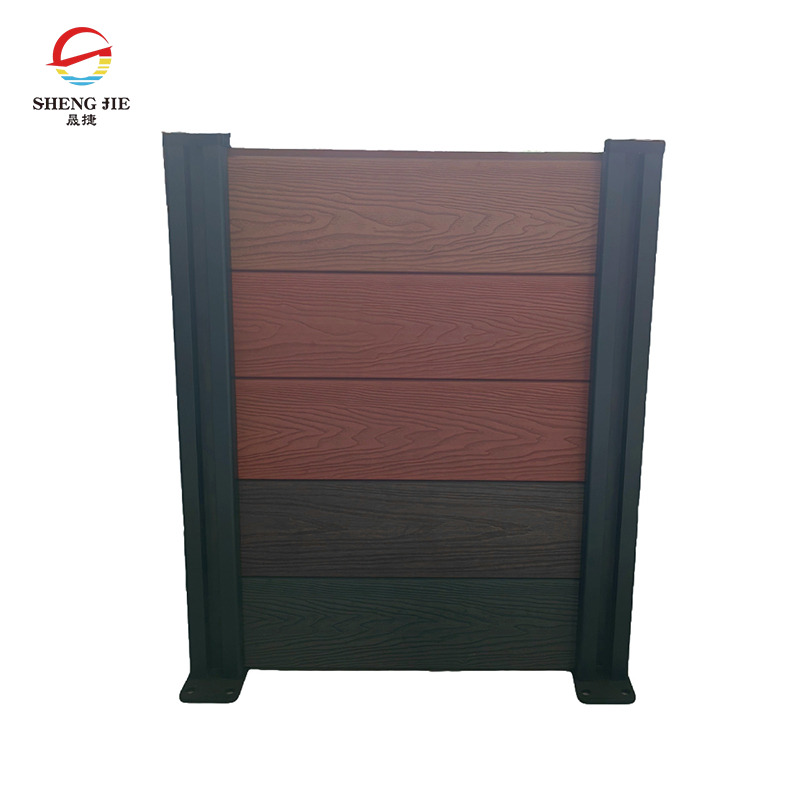
A complete fence may include infill boards, posts, top and bottom rails or trims, post caps, fasteners and accessories. Corners, ends and gates can require different components from a straight run. A board sold separately does not necessarily include any of these items, and a panel kit may still exclude foundations or gate hardware.
The WPC panel fence category provides a starting point for product selection. Before calculating quantities, establish whether the intended system uses individual stacking boards, a preassembled panel or another configuration, because the quantity calculation and installation sequence will differ.
WPC Fence Panel Cost: Compare the Whole Project
Prices vary by market, supplier, finish, quantity and project conditions. Without a specified location, currency, order volume and installation scope, a single price range would be unreliable. Request an itemized quotation and compare like with like. A panel that appears inexpensive may require separate posts, end trims, hardware and freight.
| Cost component | What affects it | How to compare |
|---|---|---|
| WPC infill | Profile, finish, color, coverage and order quantity | Use the same installed height and net coverage |
| Posts and rails | Span, height, corners, ends and structural demands | Count every post type and accessory |
| Gate assembly | Opening, frame, hinges, latch and support | Compare complete fitted gate packages |
| Foundations and labor | Soil, access, existing pavement and local rates | Ask for excavation, concrete and disposal inclusions |
| Freight and taxes | Distance, packaging, delivery terms and destination | Confirm the delivery point and excluded charges |
Begin with a measured layout. Divide the boundary into straight runs, identify each change of direction and mark the openings. A project with several short runs may use more posts and cut pieces per unit of fence than one long straight run. A gate needs its own supporting posts and hardware, so it should not be priced as an ordinary panel opening.
Ask the supplier to identify its pricing unit. A price per board, per panel, per square meter or per linear meter may describe different amounts of usable coverage. A linear price is comparable only if the finished height, infill, posts and accessories are the same. Check whether quoted dimensions refer to the manufactured board or the exposed face after boards engage with each other.
For imported orders, clarify the delivery terms, destination charges, packaging and responsibility for unloading. Confirm whether spare boards or replacement components can be ordered later, and include any extras the project requires. Treat contingency for cuts and damage as a project-specific estimate, not a universal percentage.
How to Size WPC Fence Panels
Finished height and board coverage
Start with the desired finished height above the ground, subject to applicable restrictions and the system’s structural limits. Determine whether the height includes a bottom clearance, rails, caps or decorative elements. The visible infill height may be smaller than the total fence height.
For stacked boards, ask for the installed coverage of one board after the joint is engaged. The number of boards in a section depends on the required infill height and that installed coverage; a final board or trim may need special treatment. Use the supplier’s instructions for cutting and finishing rather than assuming all profiles can be cut in the same way.
As an illustration, a buyer who divides the desired infill height by the nominal width of an interlocking board may undercount the boards because part of each board overlaps or sits inside a joint. The correct starting point is the confirmed effective coverage, followed by a check of the top and bottom details.
Post spacing and usable board length
Post-to-post spacing is not necessarily the same as the length of the board installed between posts. Boards may sit in channels or require clearance at their ends. The supplier should provide the maximum permitted span, insertion depth and movement allowance for the exact profile and height.
Do not choose a wider span simply to reduce the number of posts. A longer unsupported board may behave differently under wind or impact, and the post and foundation may also need to change. On an exposed site, have a qualified professional review the design when local requirements or project conditions warrant it.
Angles, corners and uneven ground
Make a separate measurement for each run. Corners may use dedicated posts or brackets, and a change in direction can alter the available insertion depth. Where the ground falls, a stepped layout can keep boards level while changing the elevation at the posts. The resulting opening beneath the fence needs to be reviewed against the intended use and any applicable rules.
A system designed for sloping installation may offer another option, but the configuration must be confirmed for the product. Draw the finished fence in elevation and mark each step, post height and bottom clearance. If a project has retaining walls, drainage channels or existing paving, resolve those interfaces before approving the layout.
How to Calculate Quantities Without Missing Parts
First, list the straight runs and their measured lengths. Second, identify end posts, line posts, corner posts and gate posts. Third, divide each run into permitted spans using the actual system dimensions. Finally, calculate the infill and trim for each section, including any short sections and special cuts. The last section on a run often differs from the rest.
Do not count a shared corner post twice unless the system requires two separate posts at the junction. Equally, do not assume that every corner can be made with a standard line post. Verify the supplier’s post types and hardware. A schedule prepared from the approved drawing is more reliable than a general perimeter calculation.
For the infill, calculate by installed coverage and section width, then add project-specific allowances for cuts, breakage and future replacement as agreed with the supplier. If boards have a directional grain or a surface that must face outward, include that requirement in the schedule. Mixing batches or reversing a directional board may change the appearance.
Check that the shipping dimensions are practical for the delivery route and storage area. Long boards need support during unloading and storage; stacking them unevenly or leaving them exposed in unsuitable conditions can damage the material before installation. Follow the supplier’s handling instructions.
WPC Fencing Installation: A Practical Sequence
1. Check the site before digging
Confirm the property line, any required permits or agreements, underground services and access for equipment. Mark the proposed fence line, corners and gate openings. Measure the actual ground levels and check whether the layout conflicts with drainage, retaining walls, tree roots or existing foundations.
Where the fence is intended to act as a regulated barrier, obtain the applicable design requirements separately. A decorative WPC fence should not be assumed to meet pool, fall-protection or security requirements simply because it is sold as a fence.
2. Set posts to the approved layout
Choose foundations or base connections for the actual soil, supporting structure, height, exposure and local requirements. Follow the system documentation and any project-specific engineering. There is no single hole size or post spacing suitable for every WPC fence.
Set the posts using a reference line and check both vertical alignment and the spacing needed by the infill. If the posts are attached to an existing slab or wall, confirm that the substrate and anchors can carry the expected loads. Allow concrete or other fixing materials to reach the condition required by their instructions before loading the posts.
3. Install the infill and trims
For a stacking system, fit the lower support and insert the boards in the sequence specified by the supplier. Check that each board seats correctly before adding the next. Do not force a tight fit that removes the movement allowance required by the system. For preassembled panels, use the designated brackets and fasteners.
WPC can move with temperature and moisture. The appropriate allowance depends on the formulation, length and fixing method, so use the product’s documented values instead of a generic gap. Follow the specified cutting and edge-finishing method and support boards during cutting to prevent surface damage.
4. Complete gates and inspect
Fit the top trim, caps and gate hardware as instructed. Check the gate’s swing, latch engagement and clear opening, including movement over sloping ground. Confirm that boards are secure, posts are aligned and there are no unintended openings or exposed sharp edges.
After completion, remove debris and clean the surface according to the supplier’s instructions. Keep the installation drawings, finish information and written maintenance guidance with the project records. These details are valuable if a board or fitting needs replacement later.
Questions to Resolve Before Approving a Quote
Ask for the exact product identification, installed coverage, board length, finish, color, post profile and recommended support details. Confirm whether the proposal includes all components, freight, tax, unloading and installation. Specify the destination and the planned order quantity, because both affect the commercial offer.
Request documentation for the intended use and exposure, including instructions for movement allowances and cleaning. If a fire classification, impact performance or structural rating is needed, ask for the relevant test report and its scope. A generic marketing description does not establish compliance for a particular installation.
The published information for a product may contain dimensions or descriptions that appear to refer to another product. When that happens, request a current drawing and written confirmation for the item being purchased. Do not calculate a bulk order from an ambiguous specification table.
Conclusion
The most reliable WPC fence budget begins with a measured layout and a complete component list. Compare suppliers using the same finished height, installed coverage, posts, gate, foundations and delivery scope. Then verify the permitted span, movement allowance and installation method for the specific system before committing to a quantity. Shengjie’s WPC offering provides a starting point for this process, but the quotation and drawings should establish the final dimensions and inclusions for the individual project.
FAQs
Are WPC Fence Panels priced per board or per completed section?
Either is possible. Ask the supplier to state the unit, installed coverage and included components. Convert quotations to the same finished height and scope before comparing them.
Can WPC boards be cut to fit a short fence run?
Some systems allow cutting, but the permitted cuts, edge treatment and support details depend on the profile. Confirm the method in the installation instructions before altering a board.
Do WPC fence posts need concrete foundations?
Many fence systems use concrete foundations, while some use approved base-mounted connections. The correct solution depends on the system, substrate, exposure and local requirements.
Why is installed board coverage different from nominal width?
Interlocking edges or overlaps can occupy part of the board’s manufactured width. The exposed or effective coverage is the measurement used to calculate the finished infill height.
Can WPC fencing be installed on a slope?
It may be possible using a stepped layout or a system specifically designed for sloping ground. Confirm the supported configuration and review the resulting ground clearance.
What should an overseas buyer check in the quotation?
Confirm product dimensions, quantity, packaging, delivery terms, destination charges, lead time and the scope of the written warranty. Also clarify who is responsible for unloading and local installation.


